
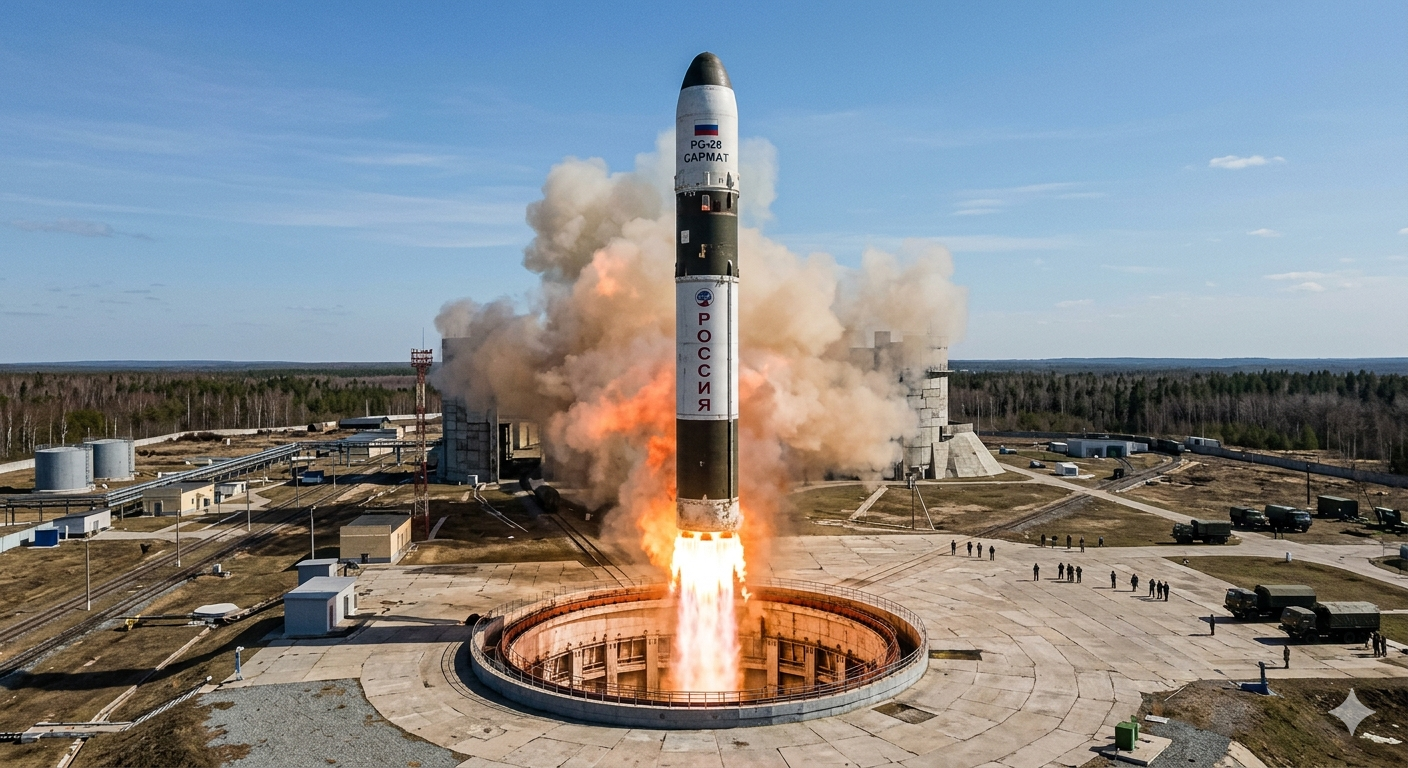
Russia’s RS-28 Sarmat, known to NATO as “Satan II,” is officially the largest, heaviest, and longest-range intercontinental ballistic missile (ICBM) in human history [militarywatchmagazine.com]. Designed by the Makeyev Rocket Design Bureau to modernize Russia’s nuclear triad, the liquid-fueled behemoth stands 35.3 metres tall, spans 3 metres in diameter, and registers a massive launch weight of 208.1 metric tonnes [csis.org]. Built specifically to replace the iconic Soviet-era R-36M2 Voyevoda (SS-18 Satan), the Sarmat serves as Moscow’s primary silo-based nuclear deterrent.
Following years of technical delays and highly publicized testing setbacks, Russia completed a major operational milestone with a successful flight test from the Plesetsk Cosmodrome. Russian President Vladimir Putin and the Strategic Rocket Forces confirmed that the weapon is scheduled for full combat deployment in the Uzhur missile base by the end of 2026.
Technical Specifications & Capabilities
The core purpose of the Sarmat is to deliver an unparalleled payload over vast distances while rendering modern Western air defense networks obsolete.
| Parameter | Specification Details |
|---|---|
| Launch Mass | 208.1 metric tonnes |
| Dimensions | 35.3 metres length $\times$ 3 metres diameter |
| Payload Capacity | 10 metric tonnes of throw-weight |
| Maximum Velocity | Mach 20.7 (approx. 25,500 km/h) |
| Operational Range | 18,000 km to 35,000+ km (via suborbital paths) |
Destructive Payload Options
Supported by its unprecedented 10-tonne throw-weight capacity, the Sarmat can be configured with highly versatile nuclear configurations:
- Heavy MIRVs: Holds up to 10 large, independently targetable thermonuclear warheads, each yielding 750 kilotons.
- Light MIRVs: Configurable with 15 to 16 lighter nuclear warheads to maximize geographic coverage.
- Hypersonic Glide Vehicles (HGVs): Can carry up to 3 Avangard hypersonic platforms. These skip along the upper atmosphere at speeds exceeding Mach 20 and execute sharp mid-flight maneuvers to evade interceptors.
- Defensive Countermeasures: Integrates a complex array of decoys, false targets, and electronic jamming suites to confuse enemy radar arrays.
Strategic Evasion Strategies
The Sarmat utilizes unique flight dynamics specifically designed to counter the United States’ Prompt Global Strike initiative and anti-ballistic missile (ABM) shields:
- Shortened Boost Phase: High-thrust liquid engines accelerate the rocket rapidly out of its launch silo. This drastically compresses the window that space-based infrared sensors (like the U.S. SBIRS) have to track its launch plume.
- Fractional Orbital Bombardment (FOBS): Rather than following a standard, predictable Arctic trajectory, the Sarmat is capable of executing suborbital paths that travel completely around the South Pole.
- Bypassing National Defenses: By attacking from the south, the missile targets vulnerable vectors that entirely bypass early-warning radars and interceptor fields concentrated in the northern hemisphere.
While Western analysts remain cautious regarding Moscow’s claims of an absolute 35,000 km suborbital range, the verified 18,000 km capability ensures Russia can comfortably hold any city on Earth at risk [csis.org]. The finalized deployment of the weapon cements a profound shift in global strategic deterrence and signals a deeply entrenched modernization of thermonuclear forces.